Why we sleep
Notes:
How Sleep Works:
Chemicals
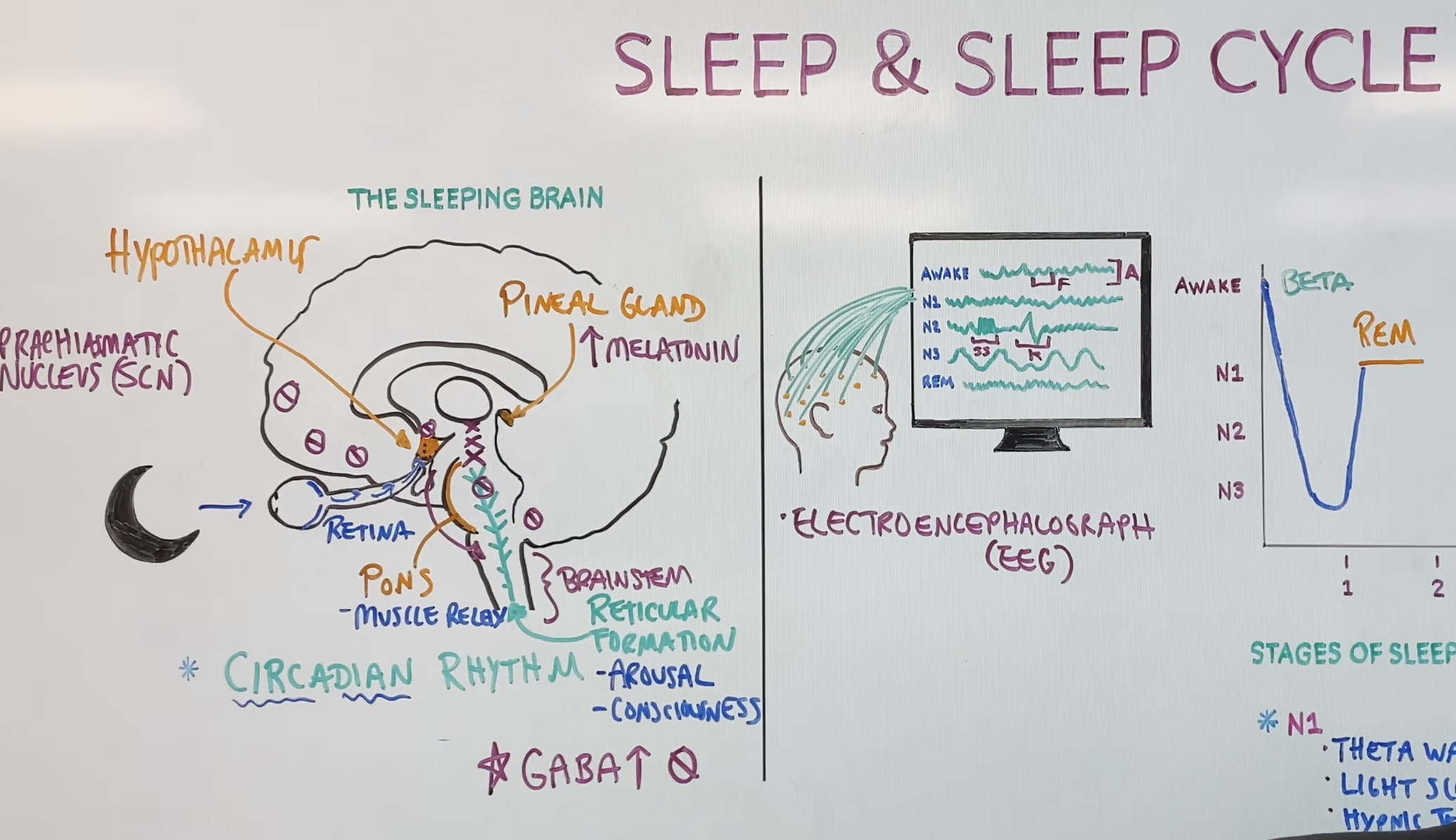
- SCN - Suprachiasmatic nucleus →Master Clock(circadian clock) + Light Sensor
- Melatonin does a lot of things during sleep, read more in there.
- Adenosine keeps getting accumulated while we are awake (as a by product of normal functions) and breaks down when we are sleeping.
- Too much of gap between Adenosine and circadian rhythm acts as Sleep pressure.
- Caffeine suppresses the adenosine’s effect, but does not clean or remove it, hence when caffeine effect’s washes off, we feel instant increased sleep pressure and feel sleepy abruptly
- GABA - (Gamma-Aminobutyric Acid)
- Primary inhibitory neurotransmitter in the brain.
- Central to sleep initiation and maintenance.
- VLPO neurons use GABA to:
- Shut down wake-promoting regions.
- Many sleep drugs (benzodiazepines, Z-drugs):
- Enhance GABAergic signaling.
- Induce sedation but may alter sleep architecture.
| Aspect | Melatonin | GABA |
|---|---|---|
| What it is | Hormone (neurohormone) | Neurotransmitter |
| Primary role | Signals time-of-day (“biological night”) | Actively induces & maintains sleep |
| Core function | Opens the sleep window | Shuts down wake-promoting neurons |
| Controls | When sleep should happen | Whether sleep actually happens |
| Speed of action | Slow, systemic | Fast, synaptic |
| Level of action | Whole-body circadian signaling | Neuron-to-neuron inhibition |
| Produced by | Pineal gland | GABAergic neurons |
| Key brain area | SCN → Pineal axis | VLPO (hypothalamus), widespread |
| Trigger for release | Darkness (lack of light) | Sleep pressure + circadian alignment |
| Effect on arousal systems | Indirect, permissive | Direct inhibition |
| Role in sleep pressure | None | Executes sleep once pressure is high |
| External supplementation | Helps shift timing (jet lag) | Oral GABA has limited BBB crossing |
| Drugs acting on it | Melatonin supplements | Benzos, Z-drugs, alcohol |
| If high alone | Sleepy but not asleep | Sleep without proper timing |
| If low | Circadian misalignment | Insomnia, hyperarousal |
The Two-Process Model of Sleep Regulation
Process C (Circadian Rhythm)
- Controlled by SCN.
- Dictates timing of sleepiness and alertness.
- Independent of how long you’ve been awake.
Process S (Sleep Pressure)
- Driven by adenosine accumulation.
- Depends on time spent awake.
- Sleep happens when:
- Circadian alertness signal drops AND
- Sleep pressure is high enough.
- Mismatch examples:
- Jet lag → Process C misaligned.
- All-nighters → Process S maxed, Process C still alert.
Key Brain Regions Involved in Sleep–Wake Regulation
Hypothalamus
- SCN - Suprachiasmatic nucleus → circadian timing.
- VLPO - Ventrolateral Preoptic Area
- Main sleep-promoting region.
- Releases GABA - (Gamma-Aminobutyric Acid) + galanin.
- Actively inhibits wake-promoting centers.
Thalamus
- Sensory gatekeeper.
- Reduces sensory input during sleep. - noise, smell shuts off
- External Sensory Input to Cortex
- Vision
- Visual signals from retina largely blocked.
- Dream imagery does not come from eyes.
- Hearing
- Most auditory signals suppressed.
- Loud or salient sounds can still break through.
- Touch / Proprioception
- Reduced processing of body sensations.
- Pain
- Pain signals attenuated (not eliminated).
- Explains reduced pain perception during sleep.
- Vestibular input
- Reduced awareness of balance and motion.
- Vision
- Things that are not shut off
- Internal Signals
- Cortical–cortical communication continues.
- Brainstem signals (esp. REM-related) still reach cortex.
- Biologically Relevant Stimuli
- Baby’s cry
- Alarm with emotional relevance
- Your name being called
- Internal Signals
Neurochemical Environment Supporting Shutdown
- Reduced arousal neurotransmitters
- ↓ Norepinephrine
- ↓ Serotonin
- ↓ Histamine
- Increased inhibition
- Net effect:
- Thalamus becomes less responsive to external input.
Basal Forebrain
- Involved in cortical activation and sleep pressure signaling.
Brainstem
- Houses arousal and REM-control systems.
Pons (Brainstem) - Assists in dreaming during REM
- Critical for REM sleep regulation.
Functions:
- Generates REM sleep.
- Sends signals to cortex → dreaming.
- Pons generates internal activation signals (PGO waves).
- Ponto-Geniculo-Occipital waves.
- Travel from:
- Pons → thalamus (lateral geniculate nucleus) → visual cortex.
Effects:
- Activates visual cortex without external input.
- Produces dream imagery (hallucination-like).Explains why dreams feel vivid but unreal.
- Sends inhibitory signals to spinal motor neurons. REM atonia (muscle paralysis).
- Pons → medulla → spinal motor neurons.
- Prevents acting out dreams.
- Neurotransmitters involved:
- Effect:
- Skeletal muscles inhibited.
- Eyes + breathing muscles spared.
- Dysfunction → REM Behavior Disorder.
Wake-Promoting Systems (Arousal Network)
- Distributed network (not a single “wake center”).
- Includes:
- Locus Coeruleus → norepinephrine
- Raphe nuclei → serotonin
- Tuberomammillary nucleus → histamine
- Basal forebrain → acetylcholine
- These systems are:
- Active during wakefulness.
- Suppressed by VLPO - Ventrolateral Preoptic Area during sleep.
Environmental Influences on Sleep Timing
- External cues shape circadian rhythm.
- Light is dominant, but not the only factor.
- Other influences:
- Meal timing
- Exercise
- Social schedules
- Temperature
- Stress
Zeitgebers (“Time Givers”)
- External signals that synchronize circadian clock.
Primary zeitgeber:
- Light
- Morning light → phase advance.
- Evening/night light → phase delay.
Secondary zeitgebers:
- Food timing
- Physical activity
- Social interaction
- Work schedules
- Consistency strengthens circadian alignment.
- Irregular zeitgebers → circadian disruption.
Todos:
- https://www.youtube.com/watch?v=LJ9Ae_j_kjI I should study the work from guy more and talk to him prolly for research.
- Research more on Andrew Huberman’s work on sleep
- Experiment and get your hands on sleep tracking systems or Talk to jain vishwa bharti or preksha instructors or Phd folsk to test Preksha Dhyaan
- Try to scientifically make sense out of sleep telekinesis that Acharya Mahapragya and Acharya shree Tulsi used to do. Maybe seek Jain Vishwa Bharti Phd scholars who have worked on similar things.
Btw
- Explore time dilation and quick thinking patterns that I have experienced and make sense out of it scientifically and explore if more sadhna can be done leveraging that.
Questions:
- During Preksha Dhyaan, which brain waves are active, Are PONS active, is Gaba released, is Adenosine broken down?
- Anger and sense of revenge when someone wakes up abruptly, seeps into Subconscious.
- Subconscious healing
- Dream optimisation - use for dharm and solving problems
- The state just before sleep, mind works very fast but I cannot remember. Lengthen the state and switch to memory and ram mode simultaneously for saving things. We can make sense of things only if we can rethink or reaccess it in memory and conclude that it was right. Usually Thinking is like in St line, we do one run and then come back to verify if that line of thought was right and then save the conclusion, but in order to come back in the line we need to save the lin of thought while we are walking it in temp variable. Pre sleep state has very low variable saving memory … need to either switch states or make saving possible to make use of that fast processing.
- PROLLY RELATED TO N1 or REM SLEEP → Although REM has highest brain activity, N1 might have high capacity too since body movement is zero and senses are also off…
Although they have termed it as hallucinations, brain is capable of inducing situations and we see theta waves which seem to be super active
- PROLLY RELATED TO N1 or REM SLEEP → Although REM has highest brain activity, N1 might have high capacity too since body movement is zero and senses are also off…
- Sexual desires and continuation of it after waking up, or enhanced version of it during 2-3 am or in second sleep in morning. Is prefrontal cortex not up at that time to bring in the filters?
- For 2-3 am is deep sleep the reason?
- Probably Yes- in NREM 3 we do not have any control and that’s why Nightfall is considered healthy meaning that you had a deep slee, but you can have deep sleep without nightfall also.
- For second sleep in morning, is high testosterone the reason?
- For 2-3 am is deep sleep the reason?