Margana (मार्गणा)
Margana (मार्गणा)
- Margana means a point/aspect through which a Jiva is examined or classified.
- Jain scriptures examine a Jiva from 14 different perspectives, called 14 Mool Marganas (मूल मार्गणाएँ).
- These 14 Marganas together have 62 forms/bheda (भेद).
- The purpose is to systematically identify the state of a Jiva and then examine other details such as its location, duration, karmic condition, etc.
- The same Jiva can therefore be described through all 14 Marganas simultaneously.
14 Mool Margana classifications
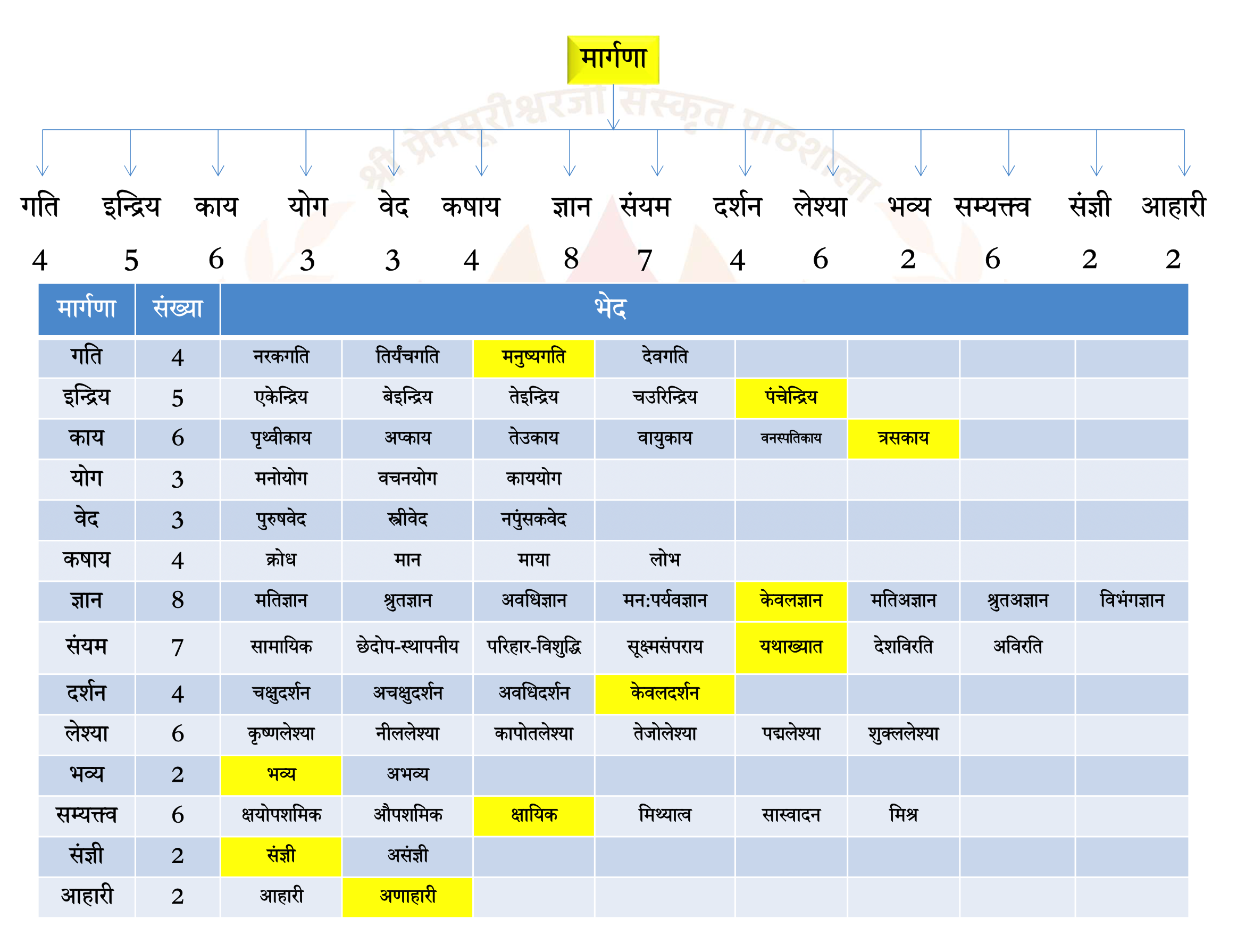
Classification
1. Gati Margana (गति मार्गणा)
- Signifier: Jiva kis Gati mein hai; i.e. which realm of existence it belongs to.
- Total: 4
1.1 Narak Gati (नरक गति)
- Signifier: Hellish existence.
- State: Intense suffering and unfavourable karmic fruition.
1.2 Tiryanch Gati (तिर्यंच गति)
- Signifier: Non-human worldly existence.
- Includes: Animals, plants and other Tiryanch Jivas.
1.3 Manushya Gati (मनुष्य गति)
- Signifier: Human existence.
- Significance: Particularly important for spiritual progress and Moksha-marg.
1.4 Deva Gati (देव गति)
- Signifier: Celestial existence.
- State: Predominantly pleasure-oriented existence.
- Limitation: Deva Gati itself does not lead directly to Moksha.
2. Indriya Margana (इन्द्रिय मार्गणा)
- Signifier: Number of senses possessed by the Jiva.
- Total: 5
2.1 Ekendriya (एकेन्द्रिय)
- Signifier: 1 sense.
- Sense: Touch (स्पर्श).
2.2 Dvi-indriya (द्वीन्द्रिय)
- Signifier: 2 senses.
- Senses: Touch + Taste (रस).
2.3 Tri-indriya (त्रीन्द्रिय)
- Signifier: 3 senses.
- Senses: Touch + Taste + Smell (गंध).
2.4 Chaturindriya (चतुरिन्द्रिय)
- Signifier: 4 senses.
- Senses: Touch + Taste + Smell + Sight (रूप).
2.5 Panchendriya (पंचेन्द्रिय)
- Signifier: 5 senses.
- Senses: Touch + Taste + Smell + Sight + Hearing (शब्द).
3. Kaya Margana (काय मार्गणा)
- Signifier: Type of body (काय) possessed by the Jiva.
- Total: 6
3.1 Prithvikaya (पृथ्वीकाय)
- Signifier: Earth-bodied Jiva.
3.2 Apkaya (अप्काय)
- Signifier: Water-bodied Jiva.
3.3 Teukaya (तेउकाय)
- Signifier: Fire-bodied Jiva.
3.4 Vayukaya (वायुकाय)
- Signifier: Air-bodied Jiva.
3.5 Vanaspatikaya (वनस्पतिकाय)
- Signifier: Plant-bodied Jiva.
- Note: Includes individual and common-bodied Vanaspati.
3.6 Traskaya (त्रसकाय)
- Signifier: Mobile-bodied Jiva.
- Includes: Dvi-indriya to Panchendriya Jivas.
4. Yoga Margana (योग मार्गणा)
- Signifier: Activity or vibration of the Jiva through mind, speech and body.
- Total: 3
4.1 Mano Yoga (मनोयोग)
- Signifier: Activity through mind.
4.2 Vachan Yoga (वचनयोग)
- Signifier: Activity through speech.
4.3 Kaya Yoga (काययोग)
- Signifier: Activity through body.
- Karmic significance: Yoga is an important condition for Asrava (आस्रव).
5. Veda Margana (वेद मार्गणा)
- Signifier: Sexual disposition (वेद).
- Total: 3
5.1 Purush Veda (पुरुषवेद)
- Signifier: Male sexual disposition.
5.2 Stri Veda (स्त्रीवेद)
- Signifier: Female sexual disposition.
5.3 Napumsak Veda (नपुंसकवेद)
- Signifier: Neuter sexual disposition.
6. Kashaya Margana (कषाय मार्गणा)
- Signifier: Four principal passions that disturb the Jiva's state.
- Total: 4
6.1 Krodha (क्रोध)
- Signifier: Anger.
- Effect: Produces agitation and karmic bondage.
6.2 Mana (मान)
- Signifier: Pride / ego.
- Effect: Creates superiority-inferiority based attachment to one's status.
6.3 Maya (माया)
- Signifier: Deceit / concealment.
- Effect: Creates crookedness between inner intention and outward conduct.
6.4 Lobha (लोभ)
- Signifier: Greed / excessive acquisition.
- Effect: Keeps the Jiva attached to desired objects.
7. Jnana Margana (ज्ञान मार्गणा)
- Signifier: Type of knowledge possessed by the Jiva.
- Total: 8
7.1 Mati Jnana (मतिज्ञान)
- Signifier: Sensory-mind based knowledge.
- Basis: Indriya and mind.
7.2 Shrut Jnana (श्रुतज्ञान)
- Signifier: Knowledge based on words, signs and previously acquired knowledge.
- Relation: Develops from Mati Jnana.
7.3 Avadhi Jnana (अवधिज्ञान)
- Signifier: Direct knowledge of certain material objects beyond ordinary sensory limits.
7.4 Manahparyaya Jnana (मनःपर्ययज्ञान)
- Signifier: Direct knowledge of another Jiva's mental states.
- Level: Higher form of knowledge than Avadhi.
7.5 Kevala Jnana (केवलज्ञान)
- Signifier: Complete and unobstructed knowledge.
- State: Perfect Jnana.
7.6 Matiajnana (मतिअज्ञान)
- Signifier: Wrong knowledge corresponding to Mati Jnana.
7.7 Shrutajnana (श्रुतअज्ञान)
- Signifier: Wrong knowledge corresponding to Shrut Jnana.
7.8 Vibhanga Jnana (विभंगज्ञान)
- Signifier: Indeterminate or incomplete knowledge.
- Contrast: Not complete like Kevala Jnana.
8. Samyama Margana (संयम मार्गणा)
- Signifier: Degree and nature of restraint (संयम).
- Total: 7
8.1 Samayik (सामायिक)
- Signifier: Equanimous restraint.
- Focus: Remaining in Samata (समता).
8.2 Chedopasthapaniya (छेदोपस्थापनीय)
- Signifier: Restored monastic conduct after a transgression.
- Focus: Correction through prescribed process.
8.3 Parihar Vishuddhi (परिहार विशुद्धि)
- Signifier: Purification through special restraint and penance.
- Focus: Greater purification of conduct.
8.4 Sukshma Samparaya (सूक्ष्मसांपराय)
- Signifier: Only extremely subtle Kashaya remains.
- State: Very high level of restraint.
8.5 Yathakhyat (यथाख्यात)
- Signifier: Conduct corresponding to the Jiva's actual spiritual purity.
- State: Highest form of Charitra (चरित्र) in this classification.
8.6 Desavirati (देशविरति)
- Signifier: Partial restraint.
- State: Some activities are renounced while others remain.
8.7 Avirati (अविरति)
- Signifier: Absence of restraint.
- State: Inability to abstain from worldly activities.
9. Darshana Margana (दर्शन मार्गणा)
- Signifier: Type of Darshana (दर्शन), i.e. non-specific perception.
- Total: 4
9.1 Chakshu Darshana (चक्षुदर्शन)
- Signifier: Non-specific perception through the eye.
9.2 Achakshu Darshana (अचक्षुदर्शन)
- Signifier: Non-specific perception without the eye.
9.3 Avadhi Darshana (अवधिदर्शन)
- Signifier: Darshana associated with Avadhi.
9.4 Kevala Darshana (केवलदर्शन)
- Signifier: Perfect and unobstructed Darshana.
- State: Associated with Kevala Jnana.
10. Leshya Margana (लेश्या मार्गणा)
- Signifier: Psychic colouring or quality of the Jiva's Bhava (भाव).
- Total: 6
- Order: More impure → progressively purer.
10.1 Krishna Leshya (कृष्ण लेश्या)
- Signifier: Darkest Leshya.
- State: Highly impure Bhava.
10.2 Neel Leshya (नील लेश्या)
- Signifier: Dark blue Leshya.
- State: Impure disposition.
10.3 Kapot Leshya (कापोत लेश्या)
- Signifier: Grey/dove-coloured Leshya.
- State: Intermediate lower purity.
10.4 Tejo Leshya (तेजो लेश्या)
- Signifier: Fiery Leshya.
- State: Comparatively purer disposition.
10.5 Padma Leshya (पद्म लेश्या)
- Signifier: Lotus-coloured Leshya.
- State: Higher purity.
10.6 Shukla Leshya (शुक्ल लेश्या)
- Signifier: White Leshya.
- State: Highest degree of purity among the six Leshyas.
11. Bhavya Margana (भव्य मार्गणा)
- Signifier: Capacity of the Jiva for Moksha (मोक्ष).
- Total: 2
11.1 Bhavya (भव्य)
- Signifier: Jiva capable of attaining Moksha.
- Note: Capability does not mean immediate or guaranteed liberation.
11.2 Abhavya (अभव्य)
- Signifier: Jiva incapable of attaining Moksha.
12. Samyaktva Margana (सम्यक्त्व मार्गणा)
- Signifier: State of Samyaktva or right belief (सम्यग्दर्शन).
- Total: 6
12.1 Kshayopashamika (क्षायोपशमिक)
- Signifier: Samyaktva through partial destruction and suppression of relevant Mohaniya Karma.
12.2 Aupashamika (औपशमिक)
- Signifier: Samyaktva through suppression of relevant Mohaniya Karma.
12.3 Kshayika (क्षायिक)
- Signifier: Samyaktva through complete destruction of Darshana Mohaniya Karma.
12.4 Mithyatva (मिथ्यात्व)
- Signifier: Wrong belief.
- State: Reality is understood in a fundamentally incorrect manner.
12.5 Sasadana (सासादन)
- Signifier: Falling state associated with loss of previously attained Samyaktva.
12.6 Mishra (मिश्र)
- Signifier: Mixed state.
- State: Right and wrong belief coexist in a mixed manner.
13. Sanjni Margana (संज्ञी मार्गणा)
- Signifier: Presence or absence of mind (मन).
- Total: 2
13.1 Sanjni (संज्ञी)
- Signifier: Jiva possessing mind (मन).
- Capacity: Able to perform mental activity.
13.2 Asanjni (असंज्ञी)
- Signifier: Jiva without mind.
- State: No developed mental faculty.
14. Ahari Margana (आहारी मार्गणा)
- Signifier: Whether the Jiva is in an Aharak (आहारक) or Anaharak (अनाहारक) state.
- Total: 2
14.1 Aharak (आहारक)
- Signifier: Ahar ग्रहण करने वाला state.
- Focus: Relationship with intake of Pudgala (पुद्गल).
14.2 Anaharak (अनाहारी)
- Signifier: Non-Aharak state.
- Focus: State in which Ahar is not being taken in.
Summary of 14 Marganas
-
Gati: 4
-
Indriya: 5
-
Kaya: 6
-
Yoga: 3
-
Veda: 3
-
Kashaya: 4
-
Jnana: 8
-
Samyama: 7
-
Darshana: 4
-
Leshya: 6
-
Bhavya: 2
-
Samyaktva: 6
-
Sanjni: 2
-
Ahari: 2
-
Total: 14 Mool Marganas with 62 subdivisions (bheda).
-
The key idea is that a Jiva can be simultaneously classified through all 14 Marganas, giving a multidimensional description of its present state.