Agams
Historical Formation and Loss of the Agams
Lord Mahavir's teaching
- Lord Mahavira attained Kevaljnana (केवलज्ञान) at age 42 after 12 years of spiritual practice.
- His Kevaljnana gave direct knowledge of all substances and their modes.
- He gave Dharmadeshana (धर्मदेशना) in the Samavasaran (समवसरण).
Ganadharas and Dvadashangi
- Indrabhuti Gautama and other Ganadharas received Mahavira's teaching.
- Gautama asked Mahavira about Tattva (तत्त्व).
- Mahavira expressed the Tripadi (त्रिपदी):
- Uppannei va (उप्पण्णइ वा)
- → It arises / comes into existence
- From utpād → उत्पन्न होना
- Utpāda (उत्पाद) = origination / arising
- Vigamei va (विगमइ वा)
- → It ceases / passes away
- From vigam → विगमन
- Vyaya (व्यय) = cessation / disappearance
- Dhuvei va (धुवेइ वा)
- → It remains / persists
- From dhruv → स्थिर रहना
- Dhrauvya (ध्रौव्य) = permanence / persistence
- Uppannei va (उप्पण्णइ वा)
- The Ganadharas organized Mahavira's teachings into the Dvadashangi.
- Thus:
Mahavira's Vani (वाणी) -> Ganadharas -> Sutra form -> Dvadashangi
Oral transmission
- The teachings were transmitted orally through successive Acharyas.
- Important lineage :
- Sudharma Swami
- Jambu Swami
- Prabhava Swami
- Successive Acharyas
- Complete knowledge of the Dvadashangi was preserved by Shrut-kevalis (श्रुतकेवली).
- Sthulibhadra Swami was the last Chaturdasha Purvi (चतुर्दशपूर्वी) in Mahavira's Shasana.
Loss of Drishtivada
- Original Dvadashangi had 12 Angas.
- The 12th Anga, Drishtivada, was eventually lost.
- Therefore the present Anga collection contains only 11 Angas.
- This is the major loss that distinguishes the present Agamic corpus from the original Dvadashangi.
Present 45 Agams
- The source describes the surviving collection as:
- 11 Angas
- 12 Upangas
- 6 Cheda Sutras
- 4 Mula Sutras
- 10 Painnayas
- 2 Chulikas
- Total = 45 Agams.
Panchangi (पंचांगी)
- Agamic teachings are described as Arth Gambhir (अर्थगम्भीर), meaning their meaning is deep.
- To explain the deeper meaning of the Mula Agams, additional explanatory literature developed.
- The five components are:
- Mula Agam (मूल आगम)
- Niryukti (निर्युक्ति)
- Bhashya (भाष्य)
- Churni (चूर्णि)
- Tika (टीका)
- Together they are called Panchangi (पंचांगी).
- Why it matters: The Agam text often cannot be understood adequately from the root text alone; the explanatory layers preserve and clarify its deeper meaning.
Adhikara for Agam Study (अधिकार)
- The fundamental right to study particular Agams is associated with the Yogoddvahana (योगोद्वहन) of those Agams.
- Sadhvis are specifically mentioned as having access to:
- Dashavaikalika Sutra
- Uttaradhyayana Sutra
- Acharanga Sutra
- Shravakas and Shravikas can listen to and understand Agamic teachings through the Guru Mukha (गुरुमुख) tradition.
- Why it matters: Agam study traditionally has a structured transmission system rather than being treated simply as unrestricted textual reading.
How to remember the six buckets
- Anga (अंग) -> main limbs of the original Dvadashangi
- Upanga (उपांग) -> subsidiary limbs associated with the Angas
- Mula Sutra (मूल सूत्र) -> foundational texts for ascetic study and practice
- Cheda Sutra (छेद सूत्र) -> disciplinary and corrective texts
- Prakirnaka (प्रकीर्णक) -> specific or miscellaneous teachings
- Chulika (चूलिका) -> auxiliary texts, especially Nandi and Anuyoga Dvara
The important distinction: These six categories classify the Agamic corpus according to their place and function in the tradition. They should not be understood as six different levels of truth or six independent philosophical systems.
Complete 45 Agam Map
11 Angas
- Acharanga Sutra Dictionary#3. Charananuyoga (चरणानुयोग)
- Sutrakritanga Dictionary#4. Dravyanuyoga (द्रव्यानुयोग)
- Sthananga Sutra Dictionary#2. Karnanuyoga (करणानुयोग)
- Samavayanga Sutra Dictionary#2. Karnanuyoga (करणानुयोग)
- Vyakhya Prajnapti / Bhagavati Sutra Dictionary#4. Dravyanuyoga (द्रव्यानुयोग)
- Jnata Dharma Katha Dictionary#1. Prathamanuyoga
- Upasaka Dashanga Dictionary#1. Prathamanuyoga
- Antakriddasha Dictionary#1. Prathamanuyoga
- Anuttaraupapatika Dictionary#1. Prathamanuyoga
- Prashnavyakarana Dictionary#3. Charananuyoga (चरणानुयोग)
- Vipaka Sutra Dictionary#1. Prathamanuyoga
12 Upanga
- Aupapatika Sutra Dictionary#1. Prathamanuyoga
- Rajaprashniya Sutra Dictionary#1. Prathamanuyoga
- Jivabhigama Sutra Dictionary#4. Dravyanuyoga (द्रव्यानुयोग)
- Prajnapana Sutra Dictionary#4. Dravyanuyoga (द्रव्यानुयोग)
- Surya Prajnapti Dictionary#2. Karnanuyoga (करणानुयोग)
- Jambudvipa Prajnapti Dictionary#2. Karnanuyoga (करणानुयोग)
- Chandra Prajnapti Dictionary#2. Karnanuyoga (करणानुयोग)
- Nirayavalika Dictionary#1. Prathamanuyoga
- Kalpavatansika Dictionary#1. Prathamanuyoga
- Pushpika Dictionary#1. Prathamanuyoga
- Pushpa Chulika Dictionary#1. Prathamanuyoga
- Vrishni Dasha Dictionary#1. Prathamanuyoga~
6 Cheda Sutras Dictionary#3. Charananuyoga (चरणानुयोग)
- Nisheetha Sutra
- Mahanisheetha Sutra
- Dashashrutaskandha
- Brihatkalpa
- Vyavahara Sutra
- Jitakalpa
4 Mula Sutras Dictionary#3. Charananuyoga (चरणानुयोग)
- Avashyaka Sutra
- Dashavaikalika Sutra
- Uttaradhyayana Sutra
- Ogha Niryukti
10 Painnayas / Prakirnakas
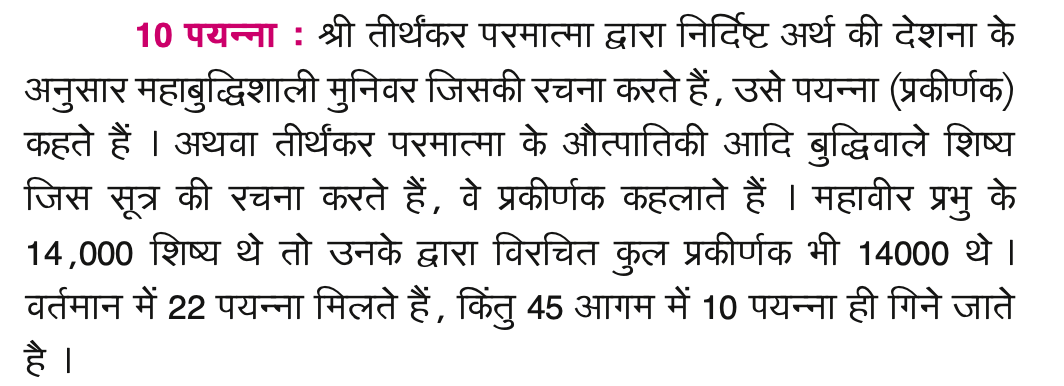
- Chatusharana Prakirnaka Dictionary#3. Charananuyoga (चरणानुयोग)
- Atur Pratyakhyana Dictionary#3. Charananuyoga (चरणानुयोग)
- Maha Pratyakhyana Dictionary#3. Charananuyoga (चरणानुयोग)
- Bhakta Parijna Dictionary#3. Charananuyoga (चरणानुयोग)
- Tandula Vaicharika Dictionary#2. Karnanuyoga (करणानुयोग)
- Samstaraka Dictionary#3. Charananuyoga (चरणानुयोग)
- Gacchachara Dictionary#3. Charananuyoga (चरणानुयोग)
- Gani Vidya Dictionary#2. Karnanuyoga (करणानुयोग)
- Devendra Stava Dictionary#1. Prathamanuyoga
- Marana Samadhi Dictionary#3. Charananuyoga (चरणानुयोग)
2 Chulikas
- Nandi Sutra Dictionary#4. Dravyanuyoga (द्रव्यानुयोग)
- Anuyoga Dvara Dictionary#4. Dravyanuyoga (द्रव्यानुयोग)
Where to go deeper
- Dvadashangi and Drishtivada -> study the original 12 Anga structure and the lost 12th Anga.
- Purvas (पूर्व) -> important for understanding what knowledge was lost along with the older tradition.
- Shrut-kevali (श्रुतकेवली) -> study how complete Agamic knowledge was transmitted through the lineage.
- Vallabhi preservation tradition -> study the transition from oral transmission to written preservation.
- Panchangi (पंचांगी) -> study how Niryukti, Bhashya, Churni and Tika relate to the Mula Agam.
- Anuyoga Dvara (अनुयोग द्वार) -> study separately because it provides the methodology for interpreting the meaning of the Agams.
Scriptures
Central Theme: The Agams (आगम) are the preserved textual tradition of Bhagavan Mahavira's teachings. Their present structure is the result of the original Dvadashangi (द्वादशांगी), its oral transmission, loss of some portions, and later preservation of related texts.
1. Angas (अंग) - 11
- Anga literally means a limb or major part.
- These are the principal divisions of the original Dvadashangi (द्वादशांगी).
- Originally there were 12 Angas.
- The 12th Anga, Drishtivada (दृष्टिवाद), is lost.
- Therefore, 11 Angas remain today.
- The Angas form the main body of the Agamic tradition.
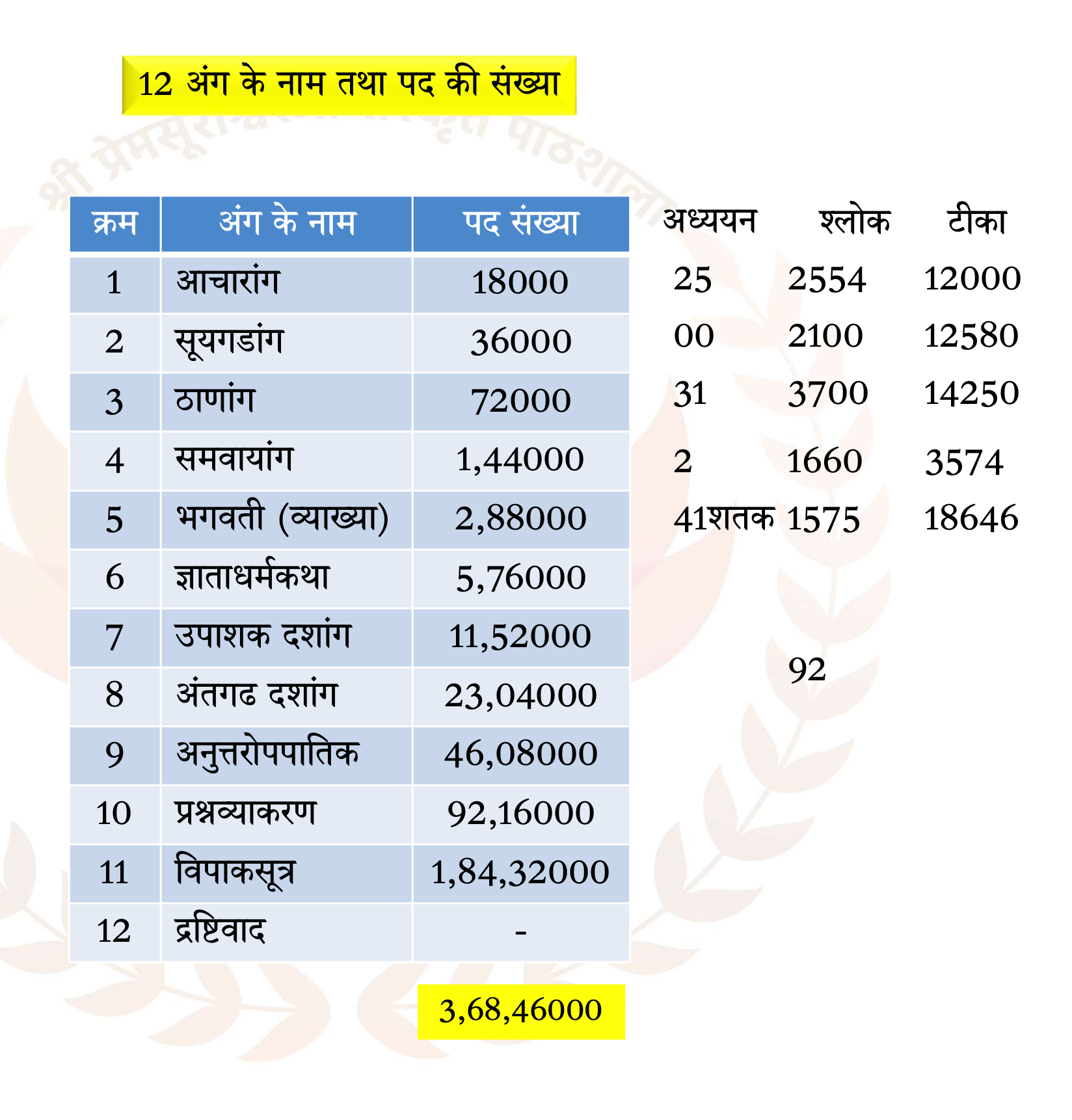
1.1 Acharanga Sutra (आचारांग सूत्र)
- Focuses on Sadhu Achara (साधु आचार) and the way of life of ascetics.
- Covers:
- Food and movement
- Rest and sleep
- Speech
- Clothing
- Happiness and suffering
- Other aspects of ascetic conduct
- Also describes Mahavira's severe spiritual practices.
- Present text:
- 25 Adhyayanas (अध्ययन)
- 2,554 verses
- Why it matters: Establishes the foundational model of ascetic conduct.
1.2 Sutrakritanga (सूत्रकृतांग)
- Examines different philosophical positions and doctrines.
- Describes 363 philosophical schools, including:
- 180 Kriyavadis (क्रियावादी)
- 84 Akriyavadis (अक्रियावादी)
- 67 Ajnanavadis (अज्ञानवादी)
- 32 Vinayavadis (विनयवादी)
- Present text:
- 2,100 verses
- Why it matters: Shows how Jain philosophy analyzes and distinguishes competing philosophical views.
1.3 Sthananga Sutra (स्थानांग सूत्र)
- Organizes subjects through numerical classifications.
- Uses numbers from 1 to 10 as the basic framework.
- Present text:
- 31 Adhyayanas
- 3,700 verses
- Why it matters: Provides a systematic numerical framework for remembering and organizing doctrine.
- The Agams were preserved primarily through oral transmission (श्रुत परंपरा).
- A numerical structure makes large amounts of information easier to:
- Memorize
- Recite
- Recall
- Cross-reference
- So the structure itself becomes a memory and preservation mechanism.
- This is particularly important in the context of the gradual loss of the original Agamic corpus.
1.4 Samavayanga Sutra (समवायांग सूत्र)
- Continues the numerical method of presenting doctrinal subjects.
- Uses progressively larger numerical classifications:
- 1 to 100
- 150, 250, 300 and onward
- Up to 10,000
- 1 lakh to 10 lakh
- Crores and larger numbers
- Present text:
- 2 Adhyayanas
- 1,660 verses
- Why it matters: Preserves large bodies of doctrinal knowledge through numerical organization.
1.5 Vyakhya Prajnapti / Bhagavati Sutra (व्याख्या प्रज्ञप्ति / भगवती सूत्र)
- Also called Bhagavati Sutra (भगवती सूत्र).
- Primarily presented through questions by Gautama Swami (गौतमस्वामी) and answers by Mahavira.
- Traditionally contains approximately 36,000 questions.
- Contains:
- 41 Shatak (शतक)
- 10,000 Uddesh (उद्देश)
- Present text:
- 1,575 verses
- Covers:
- Jiva (जीव)
- Karma (कर्म)
- Science
- Astronomy
- Geography
- Other doctrinal subjects
- Why it matters: Provides extensive doctrinal explanation through a question and answer format.
1.6 Gyata Dharma Katha (ज्ञाताधर्मकथा)
- Divided into two Shrutaskandhas (श्रुतस्कंध):
- Jnata Shrutaskandha (ज्ञात श्रुतस्कंध)
- Dharmakatha Shrutaskandha (धर्मकथा श्रुतस्कंध)
- Uses stories and narratives to communicate Dharma and doctrine.
- Why it matters: Shows how philosophical and ethical principles are conveyed through narratives.
1.7 Upasaka Dashanga (उपासकदशांग)
- Describes the lives and conduct of ten prominent Shravakas (श्रावक).
- Includes figures such as:
- Ananda
- Kamadeva
- Chulani Pitri
- Suradeva
- Chullashataka
- Kundakolika
- Saddalaputra
- Mahashataka
- Nandini
- Why it matters: Demonstrates the practice of Jain Dharma within household life.
1.8 Antakriddasha (अंतकृद्दशा)
- Describes Antakrit Kevalis (अंतकृत केवली).
- These are Kevalis who attain liberation soon after attaining Kevaljnana (केवलज्ञान).
- Contains:
- 8 Vargas (वर्ग)
- 92 Adhyayanas
- Why it matters: Shows the culmination of spiritual practice in liberation.
1.9 Anuttaraupapatika (अनुत्तरौपपातिक)
- Describes monks who attain rebirth in the Anuttara celestial abodes (अनुत्तर देव विमान).
- Contains:
- 2 Dvaras (द्वार)
- 10 Adhyayanas
- Why it matters: Connects advanced spiritual conduct with its karmic consequences.
1.10 Prashnavyakarana (प्रश्नव्याकरण)
- Contains:
- 1 Shrutaskandha (श्रुतस्कंध)
- 10 Adhyayanas
- First five Adhyayanas describe Asrava (आस्रव).
- Remaining five describe Samvara (संवर).
- Examples:
- Himsa (हिंसा) in relation to Asrava
- Ahimsa (अहिंसा) in relation to Samvara
- Why it matters: Shows the relationship between karmic influx and its prevention.
1.11 Vipaka Sutra (विपाक सूत्र)
- Describes the fruition of Punya and Papa (पुण्य और पाप).
- Divided into:
- Dukha Vipaka (दुःख विपाक)
- Sukha Vipaka (सुख विपाक)
- Why it matters: Demonstrates the relationship between karma and its fruition.
1.12 Dristivad
- Jainism teaches that in Kālacakra, there is a gradual decline during the descending half-cycle. In this age of decline, spiritual strength, memory, lifespan, and body strength all decrease. The loss of scriptures is seen in this broader framework. Such a vast text was extremely difficult to memorize and transmit perfectly over generations.
- Hence this complex aang could not sustain the test of time.
Contents
It is said to have included:
- Siddhānta and doctrine
- Karma theory
- Logic and philosophical analysis
- many forms of scriptural classification
- detailed spiritual exposition
Different Jain traditions preserve different descriptions, but broadly it is said to have contained:
- Parikarma
- Sutra
- Purvanuyoga
- Purvagata
- Cūlikā
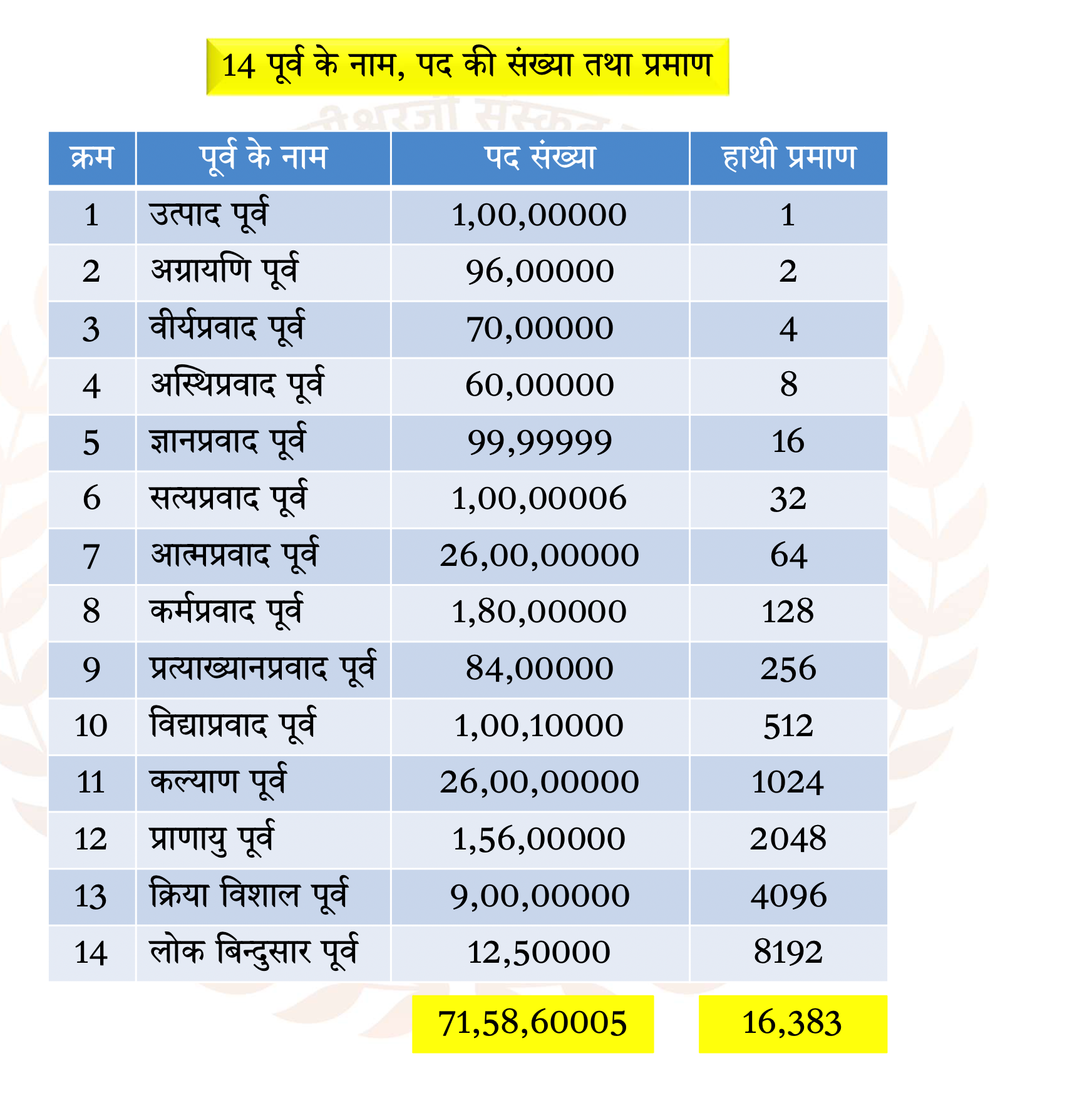
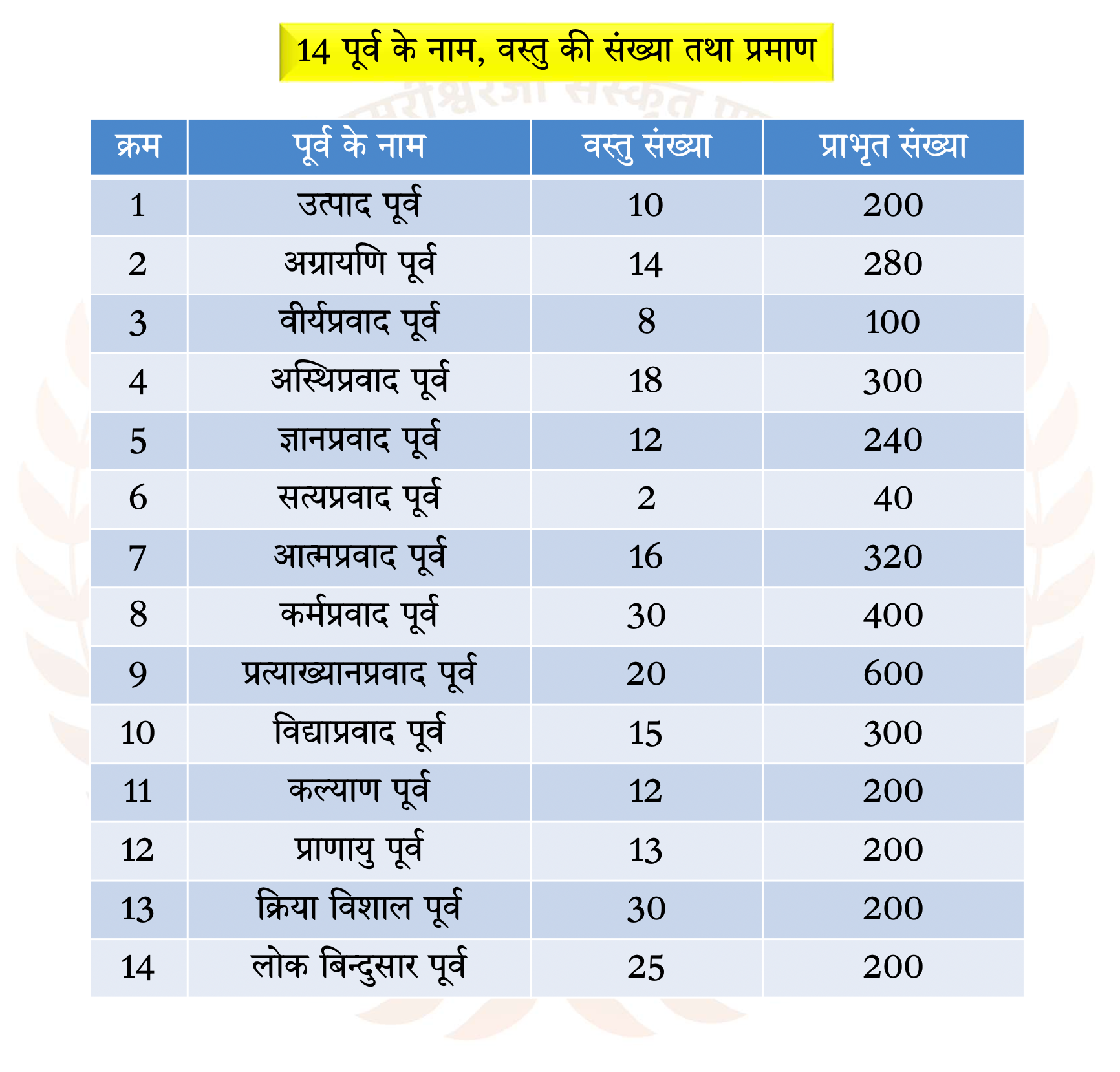
Among these, the Purvagata are especially famous. It has14 Purvas, which were highly advanced and ancient scriptural sections.
Purvagat (14 Purv)
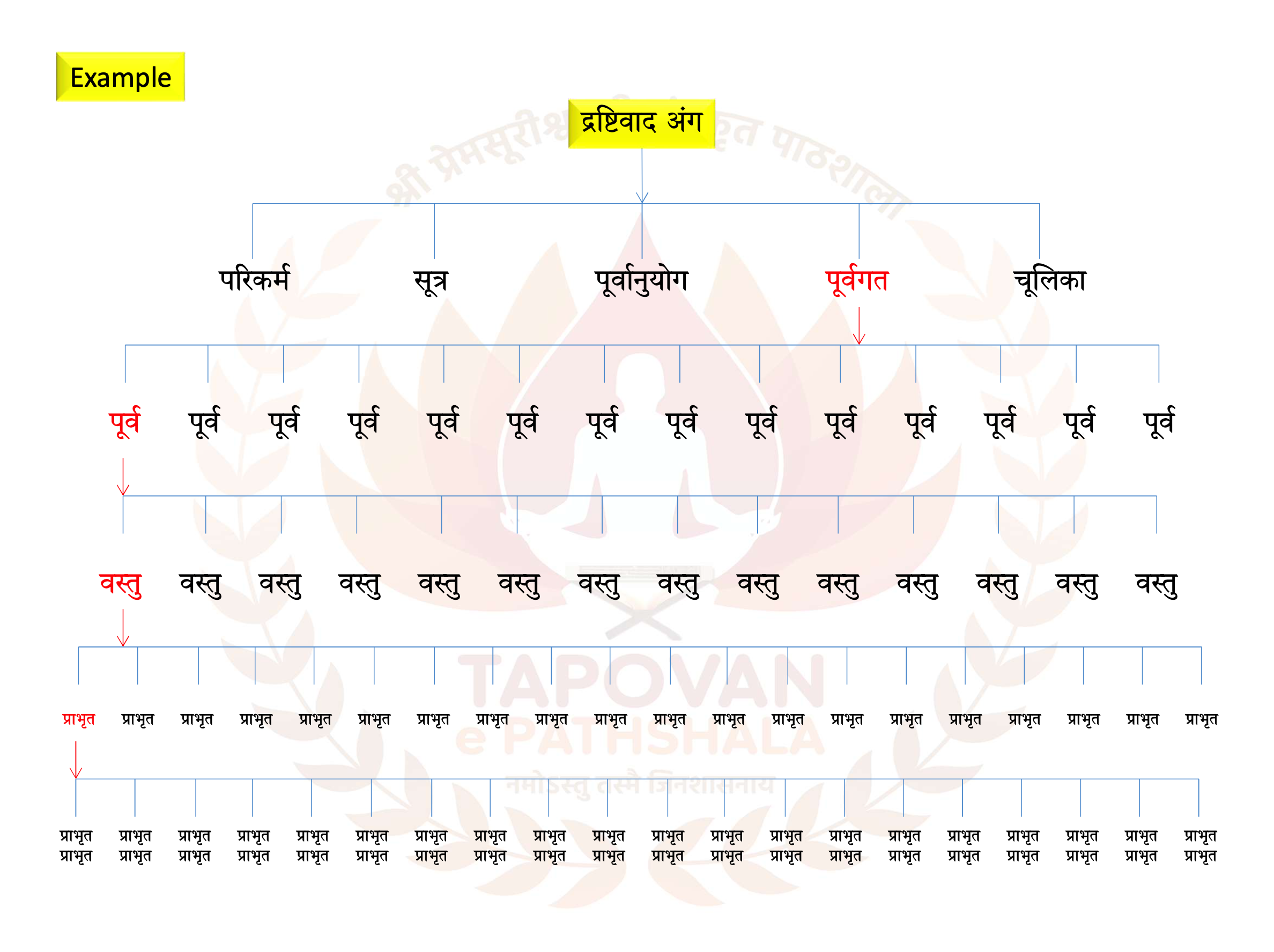
- Purvagata has 14 Purvs.
- Each purv has multiple vastu
- Each vastu has multiple Prabhrut
- Each Prabhrut has multiple Prabhrut-Prabhrut
2. Upangas (उपांग) - 12
- Upanga means a subsidiary or supporting limb.
- They are traditionally understood in relation to the Angas, like subsidiary limbs in relation to the major limbs of a body.
- There are 12 Upangas.
- They contain more focused treatments of particular subjects such as Jiva, cosmology, geography and astronomy.
2.1 Aupapatika Sutra (औपपातिक सूत्र)
- Describes the celestial rebirth of King Konika (राजा कोणिक).
- Contains 1,167 verses.
- Why it matters: Illustrates karmic consequences through a specific account of celestial rebirth.
2.2 Rajaprashniya Sutra (राजप्रश्नीय सूत्र)
- Contains:
- 1 Shrutaskandha
- 12 Adhyayanas
- 2,120 verses
- Gives a detailed description of Suryabhadeva (सूर्याभदेव)
- Why it matters: Preserves doctrinal and cosmological material through narrative exposition.
2.3 Jivabhigama Sutra (जीवाभिगम सूत्र)
- Focuses on Jiva Tattva (जीव तत्त्व).
- Gives detailed classification and description of living beings.
- Present text contains approximately 4,700 verses.
- Why it matters: Provides a focused study of the nature and classification of Jiva.
2.4 Prajnapana Sutra (प्रज्ञापना सूत्र)
- Traditionally attributed to Shyama Acharya (श्यामाचार्य).
- Present text contains approximately 7,787 verses.
- Deals with subjects belonging to Dravyanuyog (द्रव्यानुयोग).
- Why it matters: Gives systematic treatment of substances and their classifications.
2.5 Surya Prajnapti (सूर्य प्रज्ञप्ति)
- Contains approximately 2,496 verses.
- Describes:
- Sun
- Movement of the Sun
- Related astronomical phenomena
- Why it matters: Preserves Jain astronomical knowledge concerning the Sun.
2.6 Jambudvipa Prajnapti (जम्बूद्वीप प्रज्ञप्ति)
- Contains approximately 4,454 verses.
- Describes:
- Jambudvipa (जम्बूद्वीप)
- Bharata and other regions
- Mountains
- Varshadhara (वर्षधर) mountains
- Why it matters: Provides the Jain description of cosmological geography.
2.7 Chandra Prajnapti (चंद्र प्रज्ञप्ति)
- Contains approximately 2,200 verses.
- Describes:
- Moon
- Movement of the Moon
- Related astronomical phenomena
- Why it matters: Preserves Jain astronomical knowledge concerning the Moon.
2.8 Nirayavalika Group (निरयावलिका समूह)
- The last five Upangas are collectively called the Nirayavalika Shrutaskandha (निरयावलिका श्रुतस्कंध).
- They are:
- Nirayavalika
- Kalpavatansika
- Pushpika
- Pushpa Chulika
- Vrishni Dasha
2.8.1 Nirayavalika (निरयावलिका)
- Describes narratives concerning Naraka Gati (नरक गति).
- Why it matters: Illustrates consequences associated with negative karmic fruition.
2.8.2 Kalpavatansika (कल्पावतंसिका)
- Describes celestial rebirth and related narratives.
- Why it matters: Presents the consequences of particular karmic conditions in the celestial realm.
2.8.3 Pushpika (पुष्पिका)
- Contains 10 Adhyayanas.
- Describes various narrative accounts.
- Why it matters: Uses narratives to communicate karmic and religious principles.
2.8.4 Pushpa Chulika (पुष्पचूलिका)
-
Describes the birth and related narratives of celestial beings.
-
Why it matters: Develops the Agamic description of celestial existence.
2.8.5 Vrishni Dasha (वृष्णिदशा)
-
Contains 12 Adhyayanas.
-
Describes figures including Baladeva (बलदेव) and the sons of Krishna.
-
Why it matters: Preserves narrative material connected with these figures and their karmic circumstances.
3. Cheda Sutras (छेद सूत्र) - 6
-
Cheda means cutting, removing or severing.
-
The category is explained through the analogy of removing a diseased part of a body to preserve the healthy part.
-
Similarly:
-
Transgression in Charitra (चारित्र)
-
Prayashchitta (प्रायश्चित्त)
-
Restoration of proper conduct
-
-
Primarily concerned with:
-
Monastic discipline
-
Violations
-
Prayashchitta
-
Disciplinary procedures
-
-
There are 6 Cheda Sutras.
3.1 Nisheetha Sutra (निशीथ सूत्र)
-
Composed by Vishakha Gani (विशाख गणि).
-
Deals with Prayashchitta for violations involving the five forms of Achara (आचार).
-
Nisheetha means the middle portion of the night.
-
Why it matters: Provides detailed disciplinary rules for serious deviations from ascetic conduct.
3.2 Mahanisheetha Sutra (महानिशीथ सूत्र)
-
Contains 8 Adhyayanas.
-
Studied along with Nisheetha.
-
Deals extensively with:
-
Prayashchitta
-
Proper and improper methods
-
Benefits and consequences of Prayashchitta
-
-
The source describes its later reconstruction and preservation by successive Acharyas.
-
Why it matters: Shows both the disciplinary function of Cheda Sutras and the historical preservation of the textual tradition.
3.3 Dashashrutaskandha (दशाश्रुतस्कंध)
-
Bhadrabahu Swami's (भद्रबाहुस्वामी) Niryukti contains 2,106 verses.
-
Describes Dharma of:
-
Sadhus
-
Shravakas
-
-
Why it matters: Connects monastic and household religious conduct.
3.4 Brihatkalpa (बृहत्कल्प)
-
Kalpa refers to rules concerning Sadhu and Sadhvi conduct.
-
Describes:
-
Causes of Prayashchitta
-
Nature of Prayashchitta
-
Procedure of Prayashchitta
-
-
Present text contains 473 verses.
-
Why it matters: Provides detailed rules for maintaining ascetic discipline.
3.5 Vyavahara Sutra (व्यवहार सूत्र)
-
Deals with Vyavahara (व्यवहार) concerning Sadhus and Sadhvis.
-
Composed by Bhadrabahu Swami.
-
Contains:
-
10 Uddeshas
-
373 verses
-
-
Why it matters: Provides procedural rules for handling monastic disciplinary matters.
3.6 Jitakalpa (जीतकल्प)
-
Deals with Prayashchitta according to Jita Vyavahara (जीत व्यवहार).
-
Provides a disciplinary framework after the traditional Vyavahara system became interrupted.
-
Contains:
-
103 Gathas
-
2,606 verses of Svopajna Bhashya (स्वोपज्ञ भाष्य)
-
-
Why it matters: Preserves disciplinary procedures for later monastic communities.
4. Mula Sutras (मूल सूत्र) - 4
-
Mula means root or foundation.
-
These are foundational texts for newly initiated monks.
-
The source compares them with the roots of a tree:
-
Strong roots support the tree.
-
Strong foundational study supports ascetic practice.
-
-
There are 4 Mula Sutras.
4.1 Avashyaka Sutra (आवश्यक सूत्र)
-
Describes the six Avashyaka (आवश्यक) practices:
-
Samayika (सामायिक)
-
Chaturvimshati Stava (चतुर्विंशति स्तव)
-
Vandana (वंदना)
-
Pratikramana (प्रतिक्रमण)
-
Kayotsarga (कायोत्सर्ग)
-
Pratyakhyana (प्रत्याख्यान)
-
-
Why it matters: Establishes recurring practices that maintain monastic discipline.
4.2 Dashavaikalika Sutra (दशवैकालिक सूत्र)
-
Traditionally associated with the 5th Patta Parampara (पट्ट परंपरा) after Mahavira.
-
The source attributes its composition to Shayyambhava Suri (शय्यम्भवसूरि).
-
Shayyambhava Suri extracted teachings from the Purvas (पूर्व) and composed it for Manaka Muni (मनक मुनि).
-
Contains:
- 10 Adhyayanas
- 2 Chulikas
-
The source states that its composition occurred 72 years after Mahavira's Nirvana (निर्वाण).
-
Describes Sadhu Achara in detail.
-
Why it matters: Provides foundational training in ascetic conduct.
4.3 Uttaradhyayana Sutra (उत्तराध्ययन सूत्र)
-
Contains teachings attributed to Mahavira before his Nirvana.
-
Contains:
-
36 Adhyayanas
-
1,643 verses
-
Some prose material
-
-
Describes methods for cultivating Atma Guna (आत्मगुण).
-
These practices help the soul move away from attachment to Pudgala (पुद्गल).
-
Why it matters: Provides practical guidance for developing qualities required on the path to liberation.
4.4 Ogha Niryukti (ओघ निर्युक्ति)
-
Describes seven practices useful in monastic life, including Pratilekhana (प्रतिलेखना).
-
Composed by Bhadrabahu Swami.
-
Covers:
-
Charana Siddhi (चरणसिद्धि)
-
Karana Siddhi (करणसिद्धि)
-
Nature of Charitra
-
Establishment of Charitra
-
Preservation of its purity
-
-
Why it matters: Provides foundational guidance for establishing and maintaining Charitra.
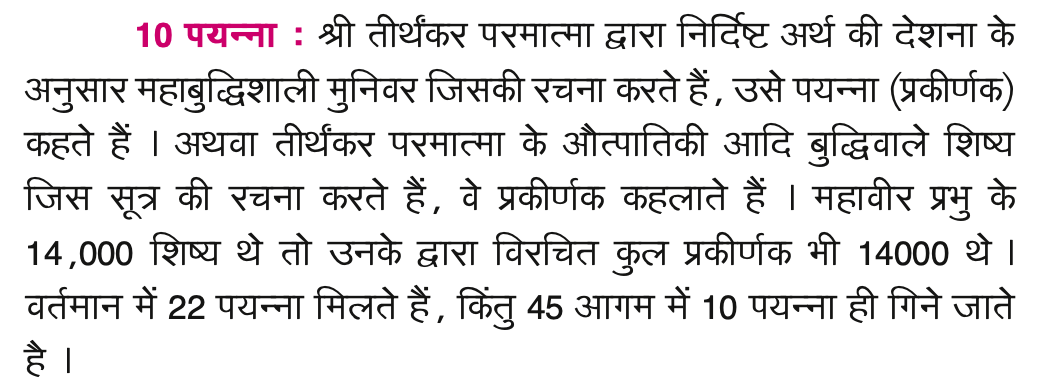
5. Painnaya / Prakirnaka (पैण्णय / प्रकीर्णक) - 10
-
Prakirnaka means a miscellaneous or particular collection.
-
These texts deal with specific subjects rather than forming the major body of the Angas.
-
The source gives two explanations for their origin:
-
Great monks composed them according to the meaning taught by the Tirthankara.
-
Learned disciples composed them based on teachings received from the Tirthankara.
-
-
Mahavira is described as having 14,000 learned disciples.
-
According to the traditional account in the source:
-
Approximately 14,000 Prakirnakas were originally composed.
-
22 are presently available.
-
10 are counted among the 45 Agams.
-
5.1 Chatusharana Prakirnaka (चतुःशरण प्रकीर्णक)
-
Also called Kushalanubandhi Adhyayana (कुशलानुबन्धी अध्ययन).
-
Composed by Virabhadra Gani (वीरभद्रगणि).
-
Describes:
-
Four Sharanas (चतुःशरण)
-
Condemnation of wrongdoing
-
Approval of meritorious actions
-
-
Why it matters: Directs the practitioner toward auspicious spiritual orientation.
5.2 Atur Pratyakhyana (आतुर प्रत्याख्यान)
-
Describes Pratyakhyana given to a person suffering from illness.
-
Intended to support:
-
Aradhana (आराधना)
-
Samadhi (समाधि)
-
-
Discusses:
-
Bala Marana (बाल मरण)
-
Bala Pandita Marana (बाल पंडित मरण)
-
Pandita Marana (पंडित मरण)
-
-
Why it matters: Explains how the approach of death can become an opportunity for spiritual practice.
5.3 Maha Pratyakhyana (महाप्रत्याख्यान)
-
Describes the final state of a Sadhu.
-
Emphasizes:
-
Endurance
-
Spiritual strength
-
Titiksha (तितिक्षा)
-
-
Why it matters: Develops the capacity to face suffering without abandoning spiritual awareness.
5.4 Bhakta Parijna (भक्तपरिज्ञा)
-
Describes final Pratyakhyana involving renunciation of food.
-
Describes three forms of final fasting:
-
Bhakta Parijna
-
Ingini Marana (इंगिनी मरण)
-
Padapopagamana Anashana (पादपोपगमन अनशन)
-
-
Why it matters: Deals with spiritual discipline surrounding the end of bodily life.
5.5 Tandula Vaicharika (तंदुल वैचारिक)
-
Discusses a very large numerical count of rice grains.
-
Primarily encourages contemplation of Ashuchi Bhavana (अशुचि भावना).
-
Also describes the condition of the embryonic Jiva (गर्भस्थ जीव).
-
Why it matters: Uses contemplation of the body to cultivate detachment.
5.6 Samstaraka (संस्तारक)
-
Describes Aradhana (आराधना) during the final stage of life.
-
Why it matters: Focuses on maintaining proper spiritual orientation near death.
5.7 Gacchachara (गच्छाचार)
-
Describes conduct within a properly organized Gaccha (गच्छ).
-
Based on:
-
Mahanisheetha
-
Brihatkalpa
-
Vyavahara Sutra
-
-
Why it matters: Provides practical discipline for the ascetic community.
5.8 Gani Vidya (गणिविद्या)
-
Contains 82 Gathas (गाथा).
-
Gives guidance to an Acharya regarding Jyotisha Vidya (ज्योतिष विद्या).
-
Why it matters: Preserves the traditional application of astronomical knowledge in monastic life.
5.9 Devendra Stava (देवेंद्र स्तव)
-
Contains 307 Gathas.
-
Composed by Virabhadra Gani.
-
Describes:
-
Indra
-
Other Devas
-
Their characteristics
-
-
Why it matters: Provides detailed descriptions of the celestial realm.
5.10 Marana Samadhi (मरण समाधि)
-
Contains 663 Gathas.
-
Describes Samadhi at death (मरण समाधि).
-
Composed by Virabhadra Gani.
-
Why it matters: Focuses on maintaining spiritual awareness and equanimity during death.
6. Chulikas (चूलिका) - 2
-
There are 2 Chulikas in the present 45 Agam classification.
-
They are:
-
Nandi Sutra
-
Anuyoga Dvara
-
-
They function as auxiliary texts within the Agamic study tradition.
-
The supplied source does not give a clear explanation of why these two are specifically grouped under the name Chulika.
-
Therefore, their functional description should not be confused with an etymological explanation of the word Chulika.
6.1 Nandi Sutra (नंदी सूत्र)
-
Focuses on the development of knowledge through:
- Adhyayana (अध्ययन)
- Shravan (श्रवण)
- Nididhyasana (निदिध्यासन)
-
Describes the five types of Jnana (ज्ञान).
-
Its purpose is connected with the development of pure qualities and ultimately Nirvana (निर्वाण).
-
It is used as a Mangala (मंगल) during the granting of the Acharya position.
-
Why it matters: Provides an important foundation for understanding knowledge and entering Agamic study.
6.2 Anuyoga Dvara (अनुयोग द्वार)
-
Anuyoga means exposition or interpretation of the meaning of a Sutra.
-
Anuyoga Dvara provides the methodology for understanding Agamic meaning.
-
The source compares it to a key that opens the box of jewels represented by the Agams.
-
Discusses:
-
Upakrama (उपक्रम)
-
Nikshepa (निक्षेप)
-
Anugama (अनुगम)
-
Naya (नय)
-
-
Why it matters: Provides the methodological framework for correctly interpreting Agamic statements.