Acharya Shri Mahapragya ji X Science
Detection of sukshm stuff
What may be detected is the subtle body, not the soul.
“यह सारी अदृश्य जगत की चर्चा है। यह उस जगत की चर्चा है, जो हमारी
इन्द्रियों का विषय नहीं है, जो हमारे द्वारा आविष्कृत उपकरणों का विषय नहीं
है। उसे जानने के लिए विशिष्ट अतीन्द्रिय ज्ञान चाहिए। वैज्ञानिकों ने आज ऐसे
उपकरण बनाए हैं, जिनके माध्यम से मृत्यु के समय स्थूल शरीर से निकलने
वाली आत्मा का फोटो लिया जा सकता है। उस समय आत्मा अकेली नहीं
होती। उसके साथ सूक्ष्म शरीर होते हैं।
वैज्ञानिक मानते हैं कि यह आत्मा का फोटो है। आत्मा का फोटो नहीं
लिया जा सकता। वह अमूर्त है। अमूर्त को कोई भी उपकरण ग्रहण नहीं कर
सकता, किंतु आत्मा जब स्थूल शरीर को छोडकर बाहर निकलती है, तब
उसके साथ सूक्ष्म शरीर अवश्य ही रहते हैं। वे सूक्ष्म शरीर दो हैं-तैजस और कार्मण।
तैजस शरीर है तेजोमय पुद्गलों का और कार्मण शरीर है कर्म पुद्गलों
का। कर्म का शरीर निश्चित ही उसके साथ रहता है। कर्म शरीर के बिना नया
जन्म नहीं होता, नया शरीर प्राप्त नहीं होता। तेजस शरीर का फोटो लिया जा
सकता है, केवल आत्मा का फोटो नहीं लिया जा सकता।”
Ultraweak Photon Emission (UPE) & Biophotonics
This is the most accurate, mainstream scientific field researching what the text calls the "Tejas" (fiery/luminous) body. 1
- The Scientific Field: Biophotonics or Quantum Biology.
- The Term: Ultraweak Photon Emission (UPE) or Biophotons. 1, 2
- The Research: Research led by scientists at the University of Calgary proved that all living organisms emit a faint, constant, invisible glow of visible light. Crucially, this biological light emission drops sharply and vanishes at the exact moment of death. 1, 2, 3, 4
- The Tool: EMCCD Cameras (Electron-Multiplying Charge-Coupled Devices), which are hyper-sensitive sensors capable of photographing single particles of light (photons) in total darkness. 1
Bioelectrography & Kirlian Photography
This field directly aligns with the book's mention of "photographing the energy around the body" via specialized high-voltage equipment. 1
- The Scientific Field: Bioelectromagnetics or Fringe Biophysics.
- The Terms: Corona Discharge, Gas Discharge Visualization (GDV), or Electrophotonic Imaging (EPI).
- The Research: In the 20th century, Russian researcher Semyon Kirlian accidentally discovered Kirlian Photography. When a living object is placed on a high-voltage plate, a glowing, colorful "aura" or silhouette is captured on film.
- The Scientific Caveat: Mainstream biophysicists proved that this glow is not a metaphysical soul. It is a physical reaction caused by the ionization of moisture and electrical current around the skin. However, researchers like Dr. Konstantin Korotkov updated this into GDV/EPI techniques, using it to capture changes in the body’s "bio-electric plasma field" right as a person passes away. 1, 2, 3
End-of-Life Biophysics & Consciousness Studies
Acharya Mahapragya mentions that the "Amurt" (formless soul) cannot be captured, but its vehicle can. Science studies this transition from a different angle. 1
- The Scientific Field: Thanatophysics (the physics of death) and Neurobiophysics.
- The Terms: Surge of Consciousness or End-of-Life Brain Dynamics.
- The Research: While science cannot verify the Karman Śarira (the subtle body made of karmic matter particles), medical scientists monitor patients at the exact moment of death. They routinely record a massive, unexplained electrical spike in brain activity (gamma wave surges) right after the heart stops. Some fringe researchers hypothesize this energy discharge is the physical system releasing its bio-electric lattice. 1, 2
How Science Maps to the Jain Terminology:
more in jainism deepdive in Sukshm Body elements - Acharya Mahapragya#Body types
| Jain Metaphysics Term | Closest Scientific Equivalent / Term |
|---|---|
| Aud arika Śarira (Gross Physical Body) | Anatomical/Biological Body |
| Taijas Śarira (Tejas / Luminous Body) | Bio-electric Field / Biophotons / UPE |
| K armaṇa Śarira (Karmic Blueprint Body) | Epigenetic / Quantum Information Field (Theoretical) |
| Atma / Jiva (Formless Consciousness) | Non-local Consciousness (Philosophy of Mind) |
Few more references - here
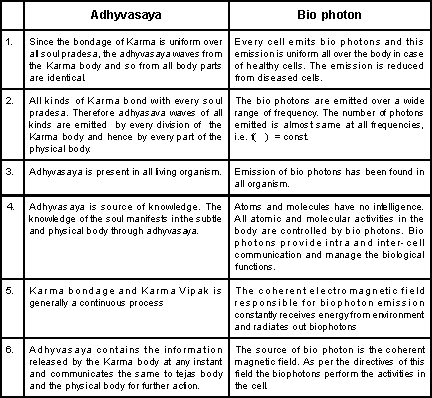
Comparison Between Adhyasaya and Bio photos
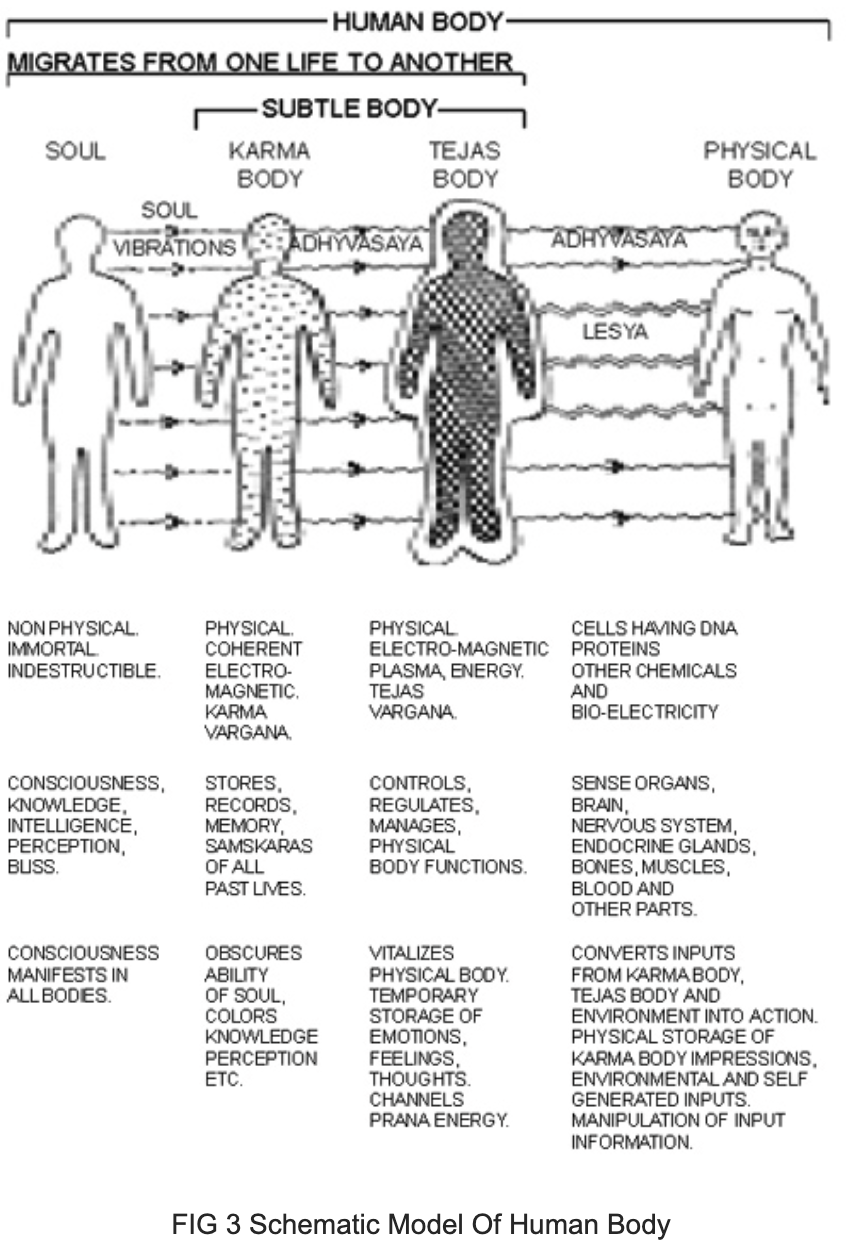
Past lives and Mental signals
“आज हम अपनी चेतना को विकसित करें, अवधिज्ञान और मन:पर्यव
ज्ञान का विकास करें, जिससे कि हजारों वर्ष पहले के शरीर की आकृतियों
को देख सकें, उसे साक्षात् कर सकें। हजारों -हजारों वर्ष पहले की, जो चिंतन
की प्रतिकृतियां हैं, उनको देखकर हम उन विचारों को जान सकें। हजारों -
हजारों वर्ष पहले बोली गई भाषा की जो वर्गणाएं हैं, भाषा के जो पुद्गल
हैं, उन पुद्गलों को हम सुन सकें। हम देख सकें और पढ सकें कि ये भाषा
की प्रतिकृतियां हैं, ये मन की प्रतिकृतियां हैं और ये शरीर की प्रतिकृतियां हैं।
चेतना के विकास के द्वारा यह संभाव्य है। ऐसा भी संभव है कि कोई वैज्ञानिक
सूक्ष्मतम यंत्रों का आविष्कार कर, उनके माध्यम से यह संभव बना सके।"
.....
“आत्मा को नहीं देख सकते, किंतु उन महापुरुषों के शरीर की आकृतियों
को देख सकते हैं। उनके द्वारा जो सोचा गया था, जो कहा गया था, उसे जान सकते हैं, पढ सकते हैं।
”
-
The Spiritual Pathway: Developing the soul’s innate higher consciousness—specifically Avadhi Gyaan (clairvoyance) and Manah-Paryaya Gyaan (mind-reading/telepathy)—to step outside the limits of time. This allows the soul to directly see, read, and hear the perfectly preserved physical replicas (पुद्गल) of past bodies, thoughts, and speech.
-
The Technological Pathway: Scientists inventing ultra-subtle, microscopic instruments (सूक्ष्मतम यंत्रों) to achieve the exact same result externally.
Quantum Information Science:
Working on the fundamental principle that physical information is never destroyed, only scrambled. It explores using quantum computing to reverse-engineer current atomic data to reconstruct its past physical states.
Micro-Vibrational Optics & Laser Doppler Vibrometry:
Using ultra-sensitive light beams and high-speed processing to filter environmental noise and read microscopic physical residues or faded electromagnetic fields.
Bio-Photonics & Cognitive Material Science:
Studying how intense human thought emits measurable electromagnetic fields and light particles (biophotons), leaving subtle atomic "imprints" on surrounding matter that sensors could eventually read.
Time-Reversal Physics:
Using advanced mathematics and wave arrays to capture scattered, distorted wave signals (like sound or electromagnetic pulses) and force them to travel backward, perfectly refocusing them into their original, pristine starting state.
The Metaphysical Synthesis: Both paths aim at the identical goal: decoding the eternal data layer of the universe. What a yogi achieves internally by clearing spiritual veils, a scientist attempts to mimic externally through advanced technological instruments.
Sound pudgal
"वैज्ञानिक जगत में यह प्रयत्न चल रहा है कि राम, कृष्ण, महावीर, बुद्ध
आदि महापुरुषों की वाणी के पुद्गलों को पकडकर हम उन्हें साक्षात् सुनें।”
-
The Metaphysical Fact: In Jainism, sound is Bhasha Pudgala—it is physical, material matter (Vargana), not empty energy. Because matter cannot be destroyed, the literal sound particles emitted by ancient teachers (like Mahavir or Buddha) still exist as highly diluted background data in space (Akasha).
-
Shrap denen me, mantrit jal, ye sab me bhi bhasha bvargana ka concept hai.
- Paani nahi peete the if bahut der reh gaya ho
-
The Science Fields:
Archaeoacoustics:
Exploring how ancient structures and caves acted as resonance chambers to trap or amplify sound.
Paleoacoustics:
The theory that historical sounds carved microscopic audio tracks into physical objects (like wet clay pots spinning on a wheel or layers of oil paint) while they were being made.
Visual Microphones:
Modern computer science (MIT, 2014) that uses high-speed cameras to reconstruct human speech just by analyzing the invisible, microscopic vibrations sound waves cause on nearby objects (like a window pane or a plant leaf).
Key Names:
-
Richard G. Woodbridge (1969): An engineer who successfully used a record-player needle to extract raw hums and audio fragments from ancient pottery grooves and oil painting brushstrokes.
-
Father Pellegrino Ernetti (1950s): An Italian monk and physicist who claimed to create the Chronovisor, a machine meant to capture the residual electromagnetic and acoustic radiation of past events to hear historical speeches.
Exploration through questions
Is all memory kind of covered by gyanavarniye karm too?(Matigyanavarniye?) Suhc that when we spend energy in thinking known things through we kinda are doing upsham, separating the clouds away to look at it? Sometimes it is removed for longer sometimes eliminated(pradeshoday) if we truly understand it? else it is a deciphered construct of what's good and what's bad and is only temporary when we are looking at it?
1. Is this why when we think about things in isolation we understand what's good and ideal to do, but we do not retain it forever, coz while acting we forget it and do as the mohniye karm dictates?
trigger
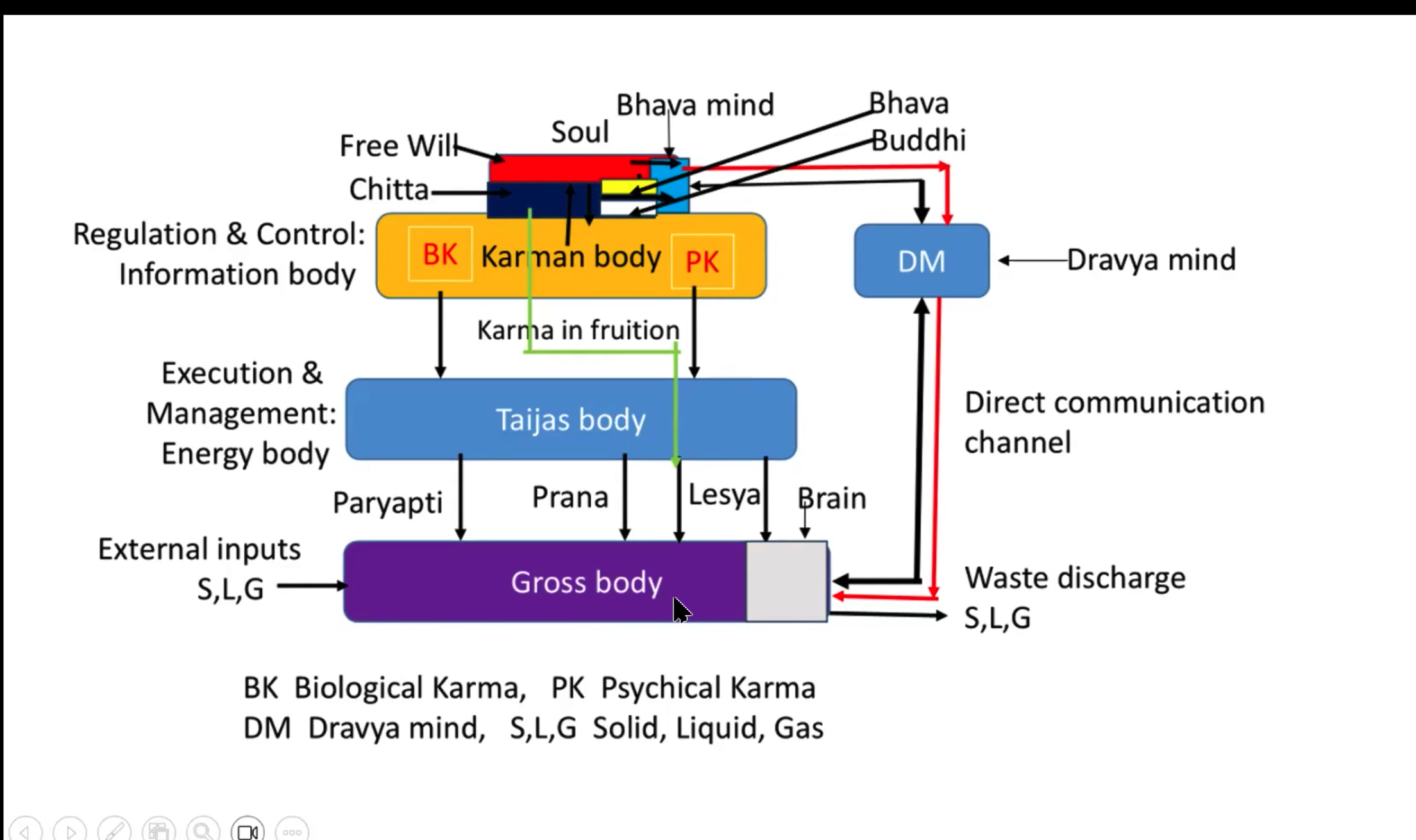
Psychology
Tools
Behaviour correlation
- Psychology says:
- subconscious influences behaviour.
- Karma Shastra asks:
- What creates the subconscious tendencies?
- Answer:
- Previously accumulated karmas (पूर्वार्जित कर्म)
- When karmas enter Udaya (उदय):
- they influence gross mind,
- which influences behaviour.
Brain Surgeries to curb Mohniye karm
“ मद्रास में 'ब्रेन इन्स्टीट्यूट' है। यह भारत का बहुत बड़ा केन्द्र
है। यहां के डॉक्टरों ने कुछ ऑपरेशन किए। उन्होंने कुछ खोजें कीं। उन्होंने
बताया कि मदिरा पीने की आदत ऑपरेशन के द्वारा छुड़ाई जा सकती है।
मस्तिष्क में एक केन्द्र है, जो मादक वस्तुओं के प्रति आकृष्ट होता है। उसकी
उत्तेजना को समाप्त कर दिया जाए तो फिर मादक वस्तुओं के सेवन की आदत
समाप्त हो जाती है, भावना समाप्त हो जाती है। उन्होंने ऐसे ऑपरेशन किए
हैं और उनमें सफल हुए हैं। उनका यह निष्कर्ष है कि अनेक आवेग, अनेक
उत्तेजनाएं, चिड़चिड़ा स्वभाव, कलह करने की वृत्ति-इन सबको मस्तिष्क के
अमुक-अमुक केन्द्रों के ऑपरेशन के द्वारा ठीक किया जा सकता है। उनको मिटाया जा सकता है।
हमारे मस्तिष्क में कई प्रकार की तरंगें पैदा होती हैं-अल्फा, बीटा, गामा
आदि-आदि। ये तरंगें हमारे में विभिन्न प्रकार की प्रवृत्तियों को उत्पन्न करती
हैं। कई प्रकार की अन्य तरंगें भी हैं, जिनका विकास यौगिक पद्धति के द्वारा
किया जा सकता है। उनका अध्ययन और परीक्षण भी किया जा सकता है।
आज की चिकित्सा-पद्धति ने इतना विकास कर लिया कि वह ऑपरेशन
के द्वारा या बिजली के झटके देकर, विभिन्न आवेगों और आदतों को मिटाने
में सक्षम है। आवेग के केन्द्र को समाप्त कर देने पर वह जीवनभर फिर कभी
सक्रिय नहीं हो सकता। काम-वासना का आवेग, कषाय का आवेग, भय का
आवेग आदि सभी आवेगों को समाप्त करने में आज का चिकित्सा-विज्ञान सक्षम है।”
Important distinction: Modern neuroscience can alter the neural expression of emotions, cravings and impulses. Jain philosophy would argue this may suppress the expression (udaya) of Mohanīya karma without necessarily destroying the karma itself.
1. Psychosurgery
Key People
- António Egas Moniz
- Walter Freeman
Core Idea
- Surgical lesions in the frontal lobes were used to reduce aggression, anxiety, compulsive behaviour and emotional instability.
Relation to Mohanīya Karma
- Demonstrates that anger, aggression and impulsive behaviour can be dramatically altered by modifying brain circuitry.
Resources
- Book: The Lobotomist — Jack El-Hai
- https://en.wikipedia.org/wiki/Prefrontal_lobotomy
2. Deep Brain Stimulation (DBS)
Key People
- Alim-Louis Benabid
- Andres Lozano
- Helen Mayberg
Core Idea
- Electrodes implanted into deep brain structures electrically modulate dysfunctional circuits without destroying tissue.
Relation to Mohanīya Karma
- Strong evidence that cravings, compulsions and emotional drives can be reduced by altering neural activity.
Resources
- https://pubmed.ncbi.nlm.nih.gov/?term=deep+brain+stimulation+addiction
- https://pubmed.ncbi.nlm.nih.gov/?term=Helen+Mayberg+deep+brain+stimulation
3. Neurosurgery for Addiction
Key People
- Luigjes et al.
- Kuhn et al.
Core Idea
- Deep Brain Stimulation of the Nucleus Accumbens reduces alcohol, nicotine and heroin cravings.
Relation to Mohanīya Karma
- Closest modern analogue to Mahapragya Ji's example of surgically eliminating addictive tendencies (Rāga/Lobha).
Resources
4. OCD Surgery (Anterior Cingulotomy / Capsulotomy)
Key People
- Bart Nuttin
- Benjamin Greenberg
Core Idea
- Lesions or DBS reduce obsessive thoughts and compulsive behaviours in treatment-resistant OCD.
Relation to Mohanīya Karma
- Demonstrates reduction of repetitive mental impulses resembling compulsive passions.
Resources
5. Reward Circuit Neuroscience
Key People
- Kent Berridge
- Wolfram Schultz
Core Idea
- Dopamine primarily encodes "wanting" (craving) rather than pleasure itself.
Relation to Mohanīya Karma
- Excellent scientific analogue for Rāga (attachment) and Lobha (greed).
Resources
- Paper: Wanting and Liking: Observations from the Neuroscience and Psychology Laboratory
- https://pubmed.ncbi.nlm.nih.gov/?term=Kent+Berridge+wanting+liking
6. Fear Circuitry
Key People
- Joseph LeDoux
Core Idea
- The amygdala is central to fear learning and fear conditioning.
Relation to Mohanīya Karma
- Maps closely to Bhaya (fear) and emotional conditioning.
Resources
- Book: The Emotional Brain
- https://pubmed.ncbi.nlm.nih.gov/?term=Joseph+LeDoux+fear
7. Emotion & Decision Making
Key People
- Antonio Damasio
Core Idea
- Damage to emotional brain regions alters morality, judgement and personality.
Relation to Mohanīya Karma
- Suggests passions and ethical behaviour are deeply dependent on neural circuitry.
Resources
- Book: Descartes' Error
- https://pubmed.ncbi.nlm.nih.gov/?term=Antonio+Damasio+emotion
8. Brain Oscillations
Key People
- György Buzsáki
Core Idea
- Alpha, Beta and Gamma oscillations coordinate cognition, attention and consciousness.
Relation to Mohanīya Karma
- Modern interpretation of Mahapragya Ji's discussion on brain waves.
Resources
- Book: Rhythms of the Brain
- https://pubmed.ncbi.nlm.nih.gov/?term=Gyorgy+Buzsaki+brain+rhythms
9. Meditation Neuroscience
Key People
- Richard Davidson
- Antoine Lutz
- Judson Brewer
Core Idea
- Long-term meditation measurably changes emotional regulation, attention networks and brain oscillations.
Relation to Mohanīya Karma
- Non-surgical pathway to reducing passions and strengthening equanimity.
Resources
- Davidson: https://pubmed.ncbi.nlm.nih.gov/?term=Richard+Davidson+meditation
- Brewer: https://pubmed.ncbi.nlm.nih.gov/?term=Judson+Brewer+craving
- Book: The Craving Mind
10. Phineas Gage Case
Key People
- John Harlow (physician)
Core Idea
- Injury to the frontal cortex permanently changed impulse control and personality.
Relation to Mohanīya Karma
- Landmark evidence that altering brain structure alters emotional tendencies and behaviour.
Resources
Fields Worth Exploring
Affective Neuroscience
Studies neural basis of emotions like fear, anger, attachment and pleasure.
Behavioral Neuroscience
Studies how brain circuits generate behaviour and habits.
Functional Neurosurgery
Brain surgery for psychiatric and neurological disorders.
Neuromodulation
DBS, TMS, Vagus Nerve Stimulation and other techniques to alter brain activity without destroying tissue.
Neuropsychiatry
Connects psychiatric symptoms with underlying neural circuits.
Computational Psychiatry
Models craving, compulsions, reward prediction and emotional disorders mathematically.
Contemplative Neuroscience
Studies how meditation changes the brain and emotional regulation.
Neuroethics
Explores whether changing the brain changes agency, morality and free will.